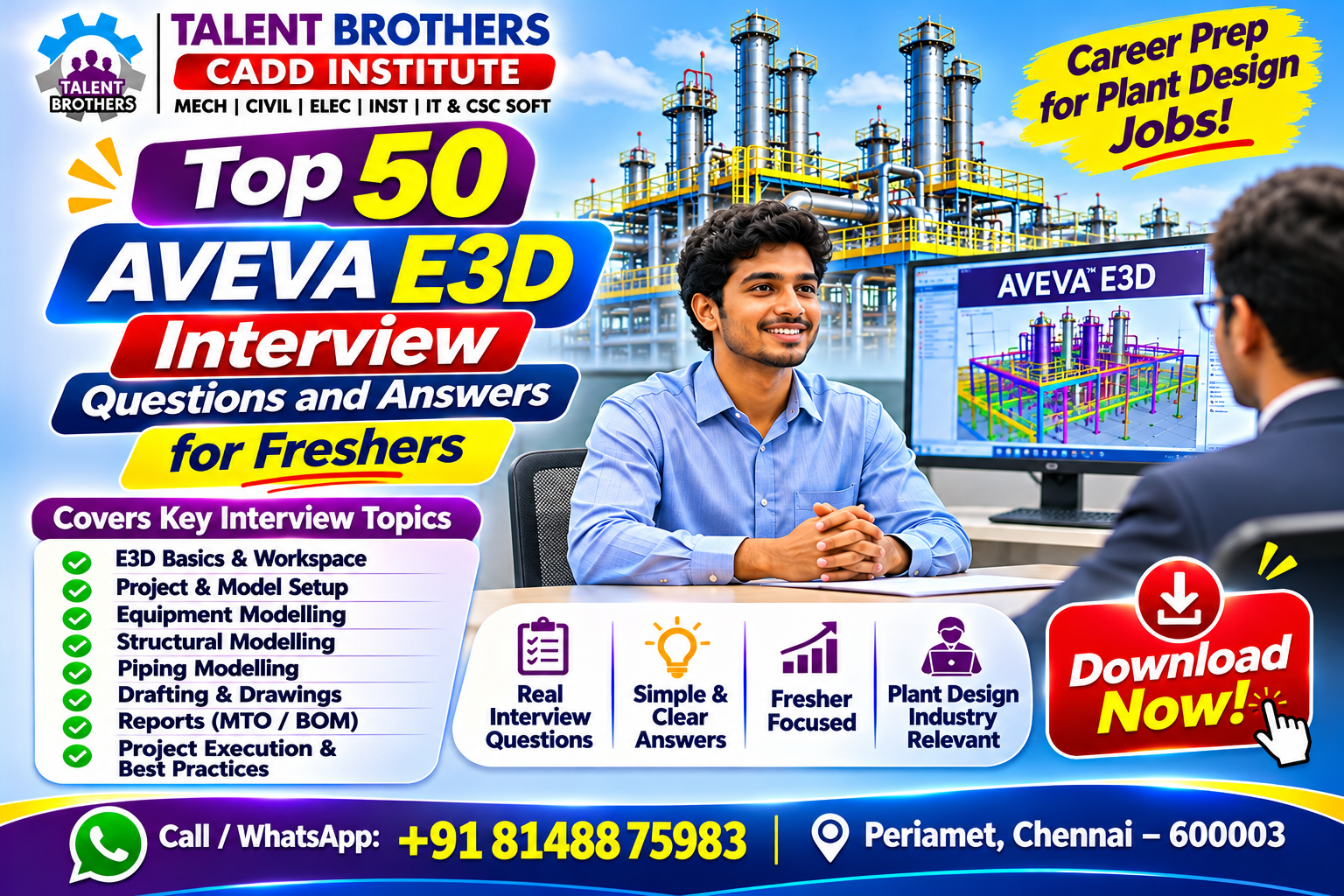
Top 50 AVEVA E3D Interview Questions and Answers for Freshers
Are you preparing for an AVEVA E3D Designer interview as a fresher? Do you want to start your career in the Oil & Gas, Petrochemical, Power or industrial plant design industry?
Learning AVEVA E3D software is an important step for engineering graduates interested in 3D plant modelling and engineering design.
AVEVA E3D (Everything 3D) is a 3D plant design software platform used to develop intelligent models of industrial facilities. It supports engineering disciplines such as piping, equipment, structural, electrical and instrumentation design.
For freshers, understanding the software interface, piping fundamentals, equipment modelling, structural concepts and basic plant design terminology is important when preparing for interviews.
In this article, Talent Brothers CADD Institute has compiled 50 commonly useful AVEVA E3D interview questions and answers to help beginners prepare.
Section 1: Basic AVEVA E3D Interview Questions
1. What is AVEVA E3D?
Answer: AVEVA E3D is a 3D engineering design software platform used for designing and modelling industrial plants. It helps engineering teams develop intelligent 3D models of piping systems, equipment, structures and other plant components.
2. What is the full form of E3D?
Answer: E3D stands for Everything 3D. It is an engineering design platform used for 3D plant modelling.
3. Where is AVEVA E3D used?
Answer: AVEVA E3D is used in industries such as:
Oil & Gas
Petrochemical
Chemical processing
Power generation
Pharmaceutical
Industrial manufacturing
4. What is plant design?
Answer: Plant design is the engineering process of planning and arranging equipment, piping, structures and other components within an industrial facility.
5. What is 3D modelling?
Answer: 3D modelling is the process of creating a three-dimensional digital representation of an object or facility. In plant design, it helps engineers visualise equipment, pipelines and structures.
6. What is the difference between 2D and 3D design?
Answer: 2D design represents objects using length and width, usually through drawings. 3D design represents objects using length, width and height, allowing engineers to visualise the complete model.
7. What is a 3D plant model?
Answer: A 3D plant model is a digital representation of an industrial facility containing equipment, piping, structures and other engineering components.
8. What is an engineering discipline?
Answer: An engineering discipline is a specialised area of engineering work. Common plant design disciplines include piping, mechanical, civil, structural, electrical and instrumentation.
9. What is the purpose of AVEVA E3D in engineering projects?
Answer: It helps engineering teams create 3D plant models, arrange components, review layouts and coordinate different engineering disciplines.
10. What is the difference between AVEVA E3D and AutoCAD?
Answer: AutoCAD is primarily used for computer-aided drafting and design, including 2D drawings and 3D modelling. AVEVA E3D is specifically designed for intelligent 3D plant engineering and modelling workflows.
Section 2: Piping Design Interview Questions
11. What is piping design?
Answer: Piping design involves planning and developing piping systems used to transport fluids and gases within industrial facilities.
12. What is a pipe?
Answer: A pipe is a hollow cylindrical component used to transport liquids, gases or other materials from one location to another.
13. What is a pipe specification?
Answer: A pipe specification defines the materials, dimensions, pressure ratings, component types and other requirements for a piping system.
14. What is a piping layout?
Answer: A piping layout shows the arrangement and routing of pipelines, fittings, valves and related components within an industrial plant.
15. What is a pipe elbow?
Answer: An elbow is a pipe fitting used to change the direction of a pipeline. Common types include 45-degree and 90-degree elbows.
16. What is a tee in piping?
Answer: A tee is a pipe fitting used to connect three pipe sections. It allows the flow to branch into another direction.
17. What is a reducer?
Answer: A reducer is a pipe fitting used to connect pipes of different diameters. It can be concentric or eccentric.
18. What is a flange?
Answer: A flange is a mechanical component used to connect pipes, valves, equipment or other piping components. Flanged connections can be dismantled for maintenance.
19. What is a valve?
Answer: A valve is a mechanical device used to control, regulate or stop the flow of fluid in a piping system.
20. What is a piping isometric drawing?
Answer: A piping isometric drawing is a 3D-style representation of a piping system shown on a 2D sheet. It provides information about pipe routing, dimensions, fittings, welds and other fabrication details.
21. What is a P&ID?
Answer: P&ID stands for Piping and Instrumentation Diagram. It is a technical drawing that represents process equipment, piping, valves, instruments and process control relationships.
22. What is a pipe rack?
Answer: A pipe rack is a structural framework used to support and route multiple pipelines within an industrial plant.
23. What is pipe routing?
Answer: Pipe routing is the process of deciding the path a pipeline follows between equipment or connection points while considering accessibility, safety, operation and design requirements.
24. What is a pipe support?
Answer: A pipe support is a component or structure used to carry piping loads and control pipe movement. Examples include shoes, guides, anchors and hangers.
25. What is a clash in piping design?
Answer: A clash occurs when two or more components occupy the same or conflicting physical space in a 3D model. Clash checking helps identify and resolve design coordination issues.
Section 3: Equipment and Structural Modelling Questions
26. What is equipment modelling in AVEVA E3D?
Answer: Equipment modelling is the process of creating 3D representations of industrial equipment such as pumps, vessels, tanks, heat exchangers and compressors.
27. What is a pump?
Answer: A pump is a mechanical device used to move liquids by adding energy to the fluid.
28. What is a pressure vessel?
Answer: A pressure vessel is a container designed to hold gases or liquids at a pressure different from the surrounding environment.
29. What is a heat exchanger?
Answer: A heat exchanger is equipment used to transfer heat between two or more fluids without necessarily mixing them.
30. What is a compressor?
Answer: A compressor is a machine used to increase the pressure of a gas by reducing its volume or adding energy.
31. What is structural modelling?
Answer: Structural modelling is the process of creating 3D representations of structural elements such as beams, columns, braces, platforms and supports.
32. What is a beam?
Answer: A beam is a structural member designed primarily to resist loads acting perpendicular to its length, usually through bending.
33. What is a column?
Answer: A column is a structural member that primarily carries compressive loads and transfers them to the foundation or supporting structure.
34. What is a platform in plant design?
Answer: A platform is an elevated working area that provides access to equipment, valves, instruments or maintenance locations.
35. Why is structural coordination important in plant design?
Answer: Structural coordination ensures that piping, equipment, platforms and other components are properly arranged without unacceptable physical conflicts or access problems.
Section 4: AVEVA E3D Software and Modelling Questions
36. What is a database in AVEVA E3D?
Answer: A database is an organised collection of engineering design information used to store and manage project model data. The database structure and access depend on the project's configuration.
37. What is a project in AVEVA E3D?
Answer: A project is the organised engineering environment containing the data, models and configuration needed to carry out plant design work.
38. What is a hierarchy in plant modelling?
Answer: A hierarchy is the structured organisation of engineering model elements. It helps users organise and manage plant components logically.
39. What is a model reference?
Answer: A model reference is a way of making model information available within a project environment. Its use depends on the project setup and software configuration.
40. What is a coordinate system?
Answer: A coordinate system is a reference framework used to define the position and orientation of objects in 3D space, commonly using X, Y and Z axes.
41. What are X, Y and Z coordinates?
Answer: X, Y and Z are three coordinate directions used to locate an object in 3D space. They generally represent three mutually perpendicular directions.
42. What is a nozzle in equipment modelling?
Answer: A nozzle is a connection point on equipment that allows piping or other components to connect to the equipment.
43. What is clash detection?
Answer: Clash detection is the process of identifying physical interferences between components in a 3D model. It helps engineering teams review and correct design conflicts.
44. What is model review?
Answer: Model review is the process of checking a 3D plant model for design accuracy, coordination, accessibility, completeness and compliance with project requirements.
45. What is MTO?
Answer: MTO stands for Material Take-Off. It is a list or quantity summary of materials required for a project, such as pipes, fittings, valves and structural components.
Section 5: General Plant Design and HR Interview Questions
46. What is the difference between P&ID and piping isometric drawings?
Answer: A P&ID shows process flow, equipment, valves and instrumentation relationships. A piping isometric drawing shows the physical piping arrangement, dimensions and fabrication-related information.
47. Why is engineering drawing knowledge important for an E3D designer?
Answer: Engineering drawing knowledge helps designers understand dimensions, symbols, layouts, connections and design requirements when developing 3D plant models.
48. What skills are important for a fresher AVEVA E3D designer?
Answer: Important skills include:
Basic engineering knowledge
Understanding of piping fundamentals
Engineering drawing interpretation
3D modelling concepts
AVEVA E3D software knowledge
Problem-solving skills
Communication and teamwork
49. Why do you want to work as an AVEVA E3D designer?
Sample answer: I am interested in industrial plant design and 3D modelling. I have learned AVEVA E3D fundamentals and want to develop my technical knowledge by working on engineering design projects. I am willing to learn from experienced engineers and improve my practical skills.
50. How will you handle a clash in an AVEVA E3D model?
Sample answer: First, I would identify the components involved in the clash and understand the design requirements. Then I would review the relevant piping, equipment or structural arrangement and discuss possible solutions with the responsible discipline engineer. I would make changes only after following the project's design and approval procedures.
Tips for Freshers Preparing for AVEVA E3D Interviews
Preparing for an interview requires more than memorising questions and answers. Freshers should also develop practical knowledge of engineering design.
Follow these preparation tips:
Learn the AVEVA E3D software interface and basic modelling workflow.
Understand piping components such as elbows, tees, reducers, flanges and valves.
Study P&ID and piping isometric drawings.
Learn basic equipment and structural modelling concepts.
Understand plant layout and clash detection.
Practise explaining your training exercises and modelling work.
Prepare a short introduction about your engineering background.
Be honest about your software knowledge and practical experience.
Learn AVEVA E3D at Talent Brothers CADD Institute, Chennai
Are you a fresher looking to develop your skills in plant design and engineering software?
Talent Brothers CADD Institute provides AVEVA E3D training for engineering students, freshers and working professionals interested in the Oil & Gas, Power and Energy industries.
Training Highlights
AVEVA E3D software training
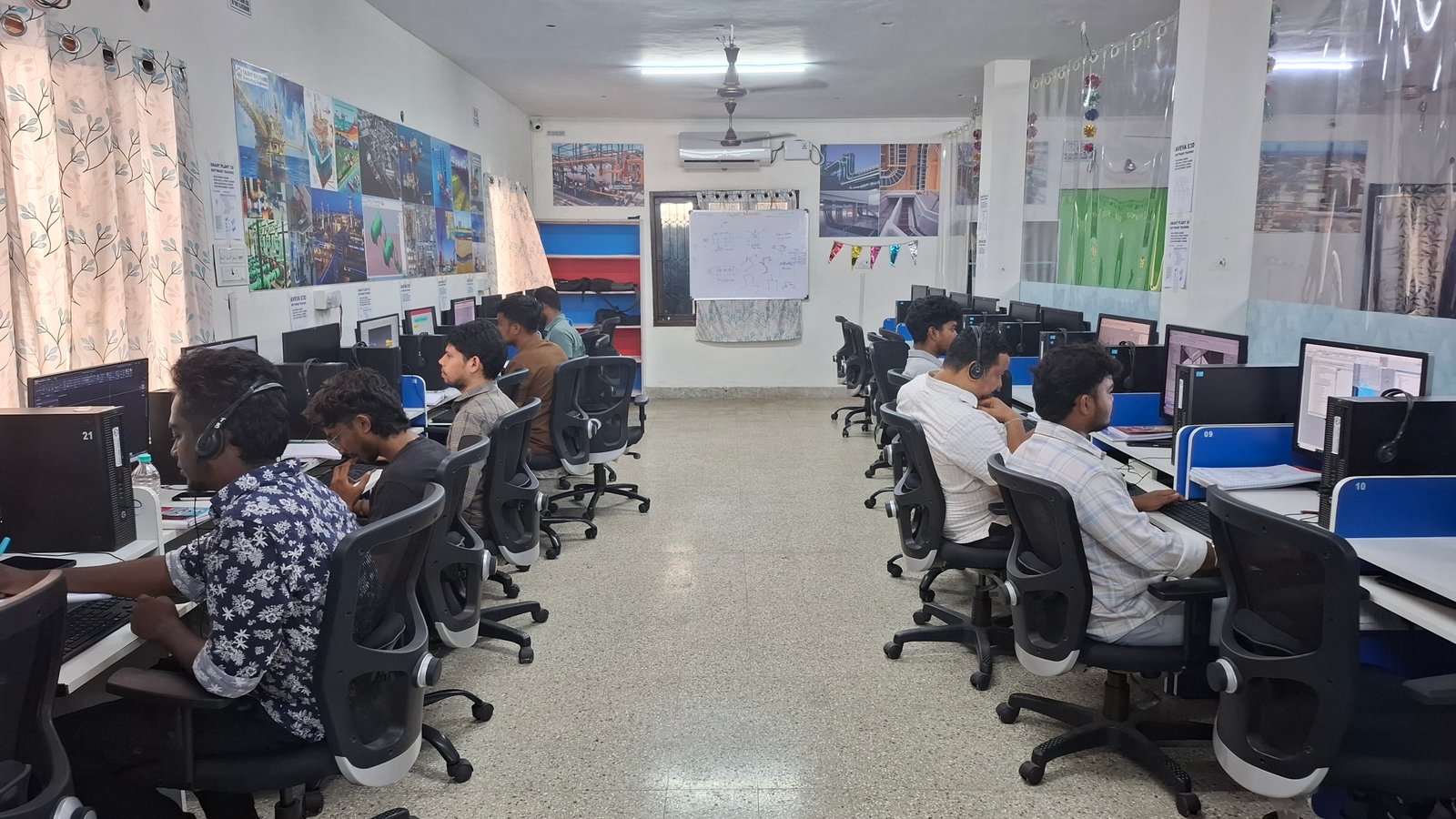
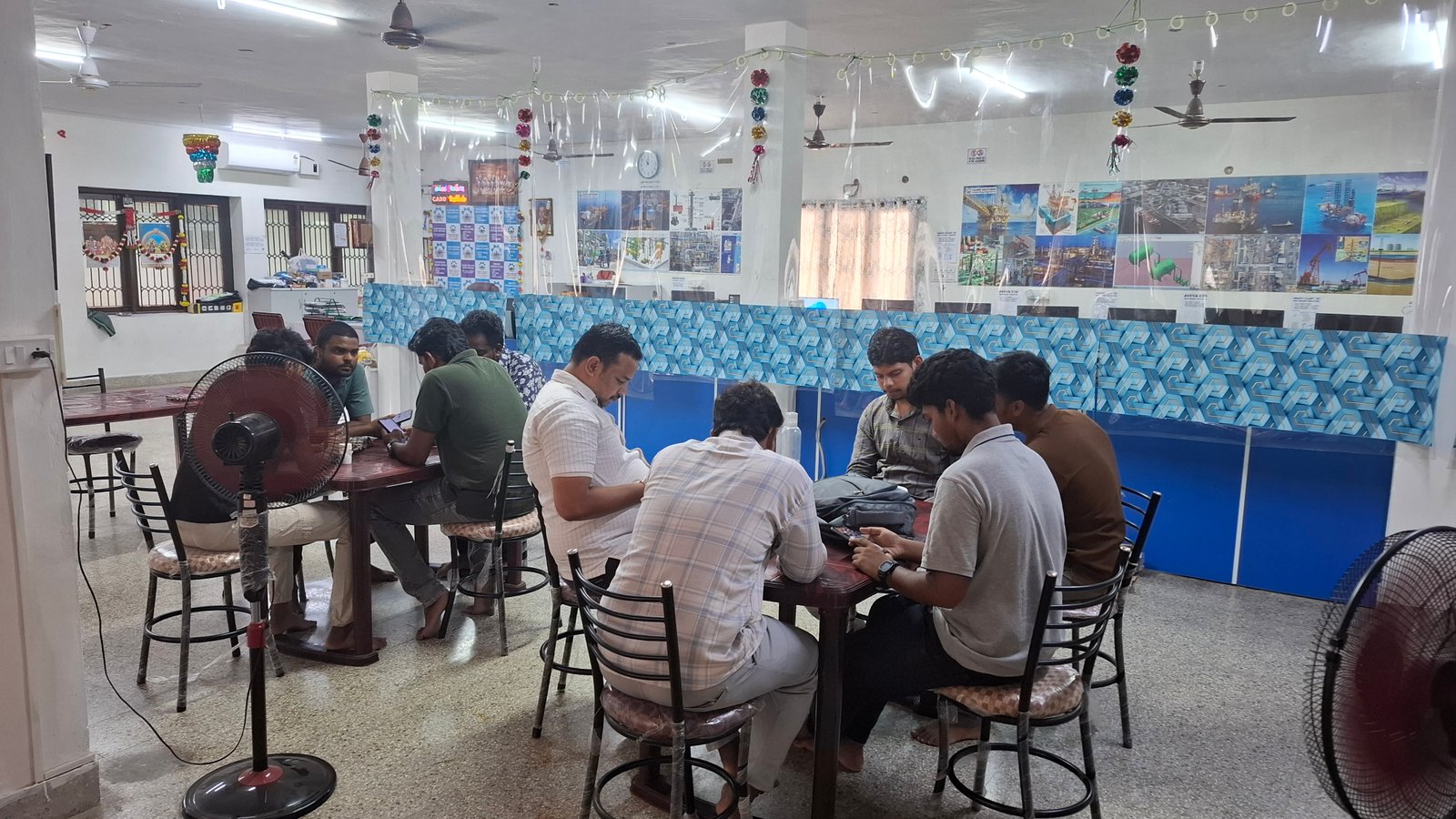
Classroom training in Periamet, Chennai
Online training options
Practical software learning
Engineering design fundamentals
Trainer guidance
Course certification
Career and job assistance
Book Your Free Demo Class!
Start developing your plant design knowledge with Talent Brothers CADD Institute.
Contact Details
Talent Brothers CADD Institute
Location: Periamet, Chennai, Tamil Nadu
Phone: +91 8148875983
Website: https://www.talentbrothers.com/
Build Skills. Build Careers.
Talent Brothers provides career and placement assistance but does not guarantee employment.